Press
Coverage since 2019: TV segments, print articles and online features, with the original clips, scans and web captures.
Video

Read the transcript
Is the sky really the limit? What's behind the trillions of galaxies in our universe? For one Indianapolis engineer, those questions are fueling the imagination of young minds. Tonight, Alex Almanza shows us how he's helping kids prepare for liftoff and reach beyond the skies. When night falls in downtown Indianapolis. A scientist is at work in his apartment, the lab. My name is Tanaka Choa, but no weird science here, no monsters, no mad experiments, and I am super enthusiastic about rockets in space, as you can see, just lots and lots and lots of rockets. Sometimes it gets jammed. For Tanaka, there's barely any room to walk in his home, but he says it's all in the name of science. My initial intent for this space was to actually have furniture. Tanaka's obsession didn't start here. It began in high school in the African country of Botswana, where he proposed a rocket club. Some people laughed at me because they thought it was like a ridiculous, outlandish idea, and it was kind of because, you know, back there the infrastructure for it wasn't really there. But things started to look up after he won an essay competition, beating the entire African continent. He later found himself in French Guiana watching an Ariane 5 launch. Yeah, I got to take the mass now. Tanaka is paving the way for the next generation by helping start a free rocket boot camp for kids in Marion County. He pitched the idea to the Minority Engineering Program of Indianapolis, and they backed it with grant funding. This brings them closer to that dream if they've had it as a kid like I had it as a kid. And this scientist's crew of aspiring engineers, they've got a mission: 1000 rockets launched from Indy by the end of the year. It's to make Indy have the most rockets per capita in the world. I am at around 80 right now. It's a mission that helps kids get involved in STEM related fields, fueling a passion much like the one that sparked Tanaka's. Space is the limit, really, and there is no limit in space. It just keeps going. And here the countdown has already begun. Liftoff. We have a liftoff in Indianapolis and in space. Alex Almanza, 13 News. So if you've got a future astronaut at your house, the program is free for families across our state. We've got more information on how you can sign up tonight on WTHR.com.
Read the transcript
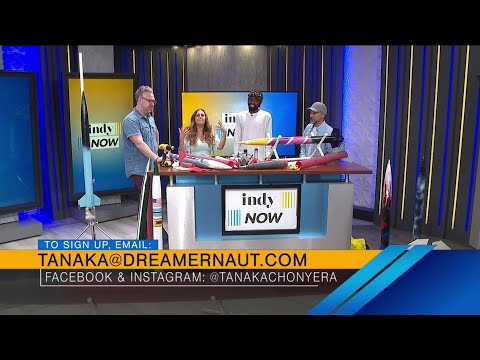
Welcome back to Indy Now, friends. This is so cool: Hoosiers, you can take part in a free high powered rocket boot camp coming up in early August. Joining us to share more, the camp's founder Tanaka, as well as our good friend Rick Snyder with the Fishers Maker Playground. Good to see you guys. How are you? And look at all these cool rockets. Tell us a little bit more about the camp and what's going on.
I created this camp with the hope to inspire kids. I think it's such a great year for space right now, and my goal is that it really starts here, with high power rocketry, to get them inspired. My hope is that one day a future mission commander or mission specialist goes into space on an Artemis mission. They get to build and make their own high power rocket, and I keep the ratio one to one. It's really important for me that they all get this experience. They build, they paint their own, they launch their own. These use the same family of fuels as a Space Shuttle, the solid boosters on Artemis, ammonium perchlorate composite propellant, and that really gets them fired up. Depending on the motor it uses different power levels. These can go to 2,000, 5,000 feet.
Oh my goodness, wow. OK, so this is happening at the Fishers Maker Playground. Nick, you've been on the show for segments before. Tell us what inspired you to start this partnership.
Tanaka's been doing this for about a year and a half, and we heard about it through the community. The first thing I thought was like the little rocket kits, and then I went and saw his social media and what they're doing, and I was like, this is amazing, how can we do this? We got in touch and he was like, heck yeah, we can do it at the Maker Playground. He's super easy to work with and we're really excited to get this off the ground. August second is going to be the first workshop. You can do registration through Tanaka's website, go through his social media and find it there. His socials are right there on the screen.
Tanaka, I know you have a really cool history with where you grew up and how you got into this.
Yeah, for sure. So I was born in Zimbabwe and then my family moved to Botswana when I was about 4 or 5 years old, and that's really where my passion started. It was for a STEM competition. I wanted to make my own rocket in high school and the resources weren't really there, so I built everything from scratch. I was met with a lot of pushback, but it took some convincing and they opened the doors to the chemistry labs. I had the time of my life. We won the STEM competition, and then there was another competition, an essay competition, and that was really cool because they flew me out to Paris, and then I got to go watch the Ariane 5 launch in French Guiana in South America. I was in the Vehicle Assembly Building. It was so cool, I was like 20 feet away from the actual thing.
This is one of the things we love about this show. I guarantee there's people out there like, oh my gosh, my grandkids would love this. How can they participate? You said it's on August 2nd.
Go to his website or through Tanaka's website, he's got the registration for the free workshop there. Follow Maker Playground on Instagram and Facebook, you'll see us posting links. Follow him, register there.
Very cool. Good luck Nick, thank you guys so much, best of luck with the launch.
It'll happen early August, go check it out. All the information is on your screen, and I did want to mention it's completely free. This is a very expensive hobby, there's a lot of cost and logistics complexity, and my goal for this is just to eliminate that barrier to entry. The launch site is out in Muncie. Everything's free, lunch provided for the all day event.
Thank you for mentioning.
Read the transcript
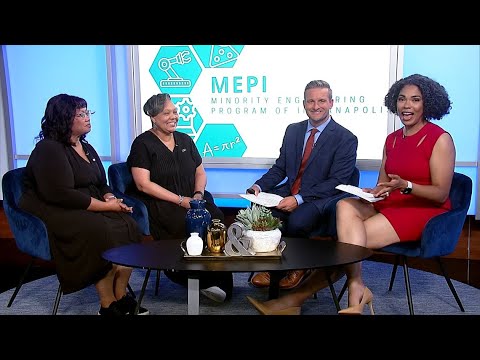
So we've all heard how important STEM learning is for students: science, technology, engineering, and math. So many careers demand those skills today, and a local program is working to make sure no students are left behind when it comes to these concepts and learning about them. The program is called MEP. It stands for Minority Engineering Program of Indianapolis, and two reps from the program are joining us now to talk about their mission and a special event tomorrow. So Holly and Marilyn, hi, thank you for being here. How are you all helping get more kids interested in STEM?
Thank you so much. So the Minority Engineering Program of Indianapolis, that we fondly call MEP, we use mentors that are engineers throughout Indianapolis to serve, and the overall goal of the program is to increase knowledge about STEM by exposing students 6th through 12th grade through a Saturday program. And we want a lot of participants. We average about 25 students per grade level, and Marilyn was one of those students, a proud success story.
So there's an event tomorrow supporting the work that you all do. More than $60,000 in scholarships will be awarded, right? Tell us about that.
Yes, lots of the organizations that support MEP provide financial support, and we are able to provide scholarships for all of the seniors that are in the program this year as they're moving on to pursue their careers in college.
Like true engineers they are of course able to quantify their data and the success that's happening here, but it was so impressive we wanted to share it. You've helped almost 6,000 students over the past 40 years learn about STEM careers. In the past 6 years they've had 100% of their students go to college, and 80% of those students declared STEM majors. Incredible. What's the key to success here? What are you all doing differently that you feel like maybe our school systems could adopt, or parents need to pay attention to?
The biggest thing is mentorship. All of the individuals involved in the leadership as well as in the facilitation of the programs are volunteers with STEM backgrounds, and so the students are able to see people who are volunteering with them, but their day job is in some kind of engineering capacity, or has been. And so the conversations, from industrial engineering to chemical to mechanical, we're able to show them not just theory but how they might actually apply it, and share with them what we're doing, and it sparks a lot of interest. We also do field trips to a lot of different places across the city, and I think that has a big impact, because when kids can see something, they use their visual senses and they can really identify with it.
Well, we're out of time, but I do want to ask really quickly: if parents who are watching this afternoon want to get their kids involved, how can they do that?
They go to mepai.org and they can get additional information.
All right, and we'll link that to our website, WTHR.com. Thank you ladies so much for joining us, and congratulations on your success.

Read the transcript
Like 60% of Africa is under 25, and the median age in Africa is 18. So if there's anyone that's going to make a difference, it has to be the youth, and I want to be a big part of that. Everyone always looks to the Western world as the frontier of cutting edge technology. I want it to be in Africa.
Another passion of mine is renewable energy, so my friend Wayne and I at school have designed and made a prototype for a parabolic mirror to produce electricity. It focuses sunlight onto a focal plane, and that either heats up a fluid or water. Heating the fluid can then be used to generate steam for electricity; heating the water can then be used to provide hot water. Typically this one uses a reflective surface. A normal solar panel basically knocks electrons off of silicon and that produces a potential difference, but this one is focusing the sunlight.
Wow. I have a strong feeling that this young man, his brain and how he thinks, it's coming from the mother. Let me just hear: mom, what do you do, and how did you impact this man?
Well, I'm a realtor, I'm a real estate agent.
Okay, so he's selling property!
Yes, but I've always been there for him to support his wild dreams. And he's always aimed high, he's always wanted to be an achiever. He's always told me, "Mommy, I'll do something great, something that the world will know me for." So I think the dream is closer to being realized, with God's blessings of course.

Read the transcript
Hey everyone, it's my last day here in South America. This has been the trip of a lifetime. The rocket launched yesterday and it was amazing. I wish everyone could get the chance to see a live rocket launch, because it is hands down the greatest thing I have ever seen. You see the rocket first, it lights up and it's like staring directly into the sun, and then you hear all the vibrations and the motors running. It's just been amazing. I'm really sad to be leaving, but I'm never going to forget this place. And once again I'd like to thank MultiChoice and Eutelsat for this life-changing experience.

Skip to 1:15 for the announcement. This is the moment astronaut Paolo Nespoli called me "the next Nobel Prize winner".
Read the transcript
Presenter: For the essay winner, I would like to call Dr. Angela Lamte for taking the envelope. Thank you. And the winner is...
Astronaut Paolo Nespoli: Thank you very much. OK, so the essay indicates a deep pre-existing passion and commitment for space science and technology. It is clear that he has cultivated his passion with research and study that have resulted in sound knowledge and understanding of the subject matter. Furthermore, he transformed his passion and knowledge into practical application. Within the essay, the contestant outlines the benefits of each proposal and possible ways to implement them. The contestant proposes several forward-looking, disruptive and intriguing ideas not yet commonly explored or embraced. And the winner is: Tanaka Chonyera, from Botswana!
Astronaut Paolo Nespoli: We had a good discussion about him. We had to call him, because we were not quite sure if he's crazy or the next Nobel Prize winner or something like that. And we actually put our money on the second one, so that's good.

Read the transcript
MultiChoice representative: Before joining MultiChoice, I went around the continent, about five African countries. My performance was in the sciences. Did I study science in school? Yes. Did I do it in university? No, I did business studies, but then I thought I'll go to the scientists and teach them how to do it. In ICT I worked for brands like Microsoft and Verizon.
So today it is really an honor and a privilege to be addressing you, and it is for a very, very good cause. As you know, your very own Tanaka did this amazing thing by winning the 2019 DStv Eutelsat Star Awards competition, and here we are to hand over him a prize. This represents a brilliant mind from Botswana, and we are so proud of that. So we hope you can also join with us to wish him well, because he's going to grow.
I just want to tell you about MultiChoice. These school competitions: it is the very first time we've ever won this award in Botswana. We've also decided that we're going to work hand in hand with the communities in which we operate, through our MultiChoice Talent Factory. I'm sure you saw the call for entries, and we had a lot of entrants for that. In addition to the Talent Factory we also have the master classes that we run for creatives here, and we also have a portal where creatives can connect with each other, and thereby we are engaging talent. Every year we'll take two students to attend this Talent Factory for a year. Our first graduate batch is this October, then another one will start.
So to the students, those who are still here to graduate high school: we encourage you to follow in his footsteps and emulate this excellence, because there is always some sort of competition out there, some run by places like Michigan State University, some held on the continent. So do look out there to find out how you can also excel the way that he has done. I would like to believe that it would do you good, and you would make us proud again to have that achievement coming back to Botswana.
So here we are to congratulate Tanaka and present to him an Explora DStv decoder and a DStv subscription. As they say: bon voyage, have a great time in Paris and watching the satellite launch. We're very proud of you. Let's have one more round of applause. And now it's time for classes.
Broadcast and online

"Indianapolis engineer launches free rocket boot camp for kids", a broadcast and online feature on the local NBC affiliate.

The WTHR feature was picked up and syndicated on iHeart's Morning Rush.

A live studio segment with the City of Fishers, cross-aired on CBS4 Indianapolis.

"18-year-old Tanaka Chonyera wants to lead Zimbabwe to space", plus Botswana national TV and radio.

Millions of views across major communities; nine posts over 100K views, three over 380K.
Web captures
Dated captures of the online coverage and partner listings, in case a page moves or disappears. Each one is downloadable as the full original capture (a searchable PDF) with its text and the live link underneath. The WTHR article capture is on the Recognition page.
iHeartRadio, 97.5 WCOS Morning Rush: "Rocket Scientist Launches Rocket Camp For Kids"

Read the text
Rocket Scientist Launches Rocket Camp For Kids
Tanaka Chonyera has launched a free rocket boot camp for kids in Marion County, Indiana, through the Minority Engineering Program of Indianapolis. He pitched the idea to the nonprofit's board, which supported it with grant funding so students can participate at no cost. The program allows children to build and launch their own rockets while learning hands-on engineering skills.
Chonyera's interest in rocketry began in high school in Botswana, where he proposed building a rocket for a STEM competition despite limited resources and doubts from others. He later won an essay competition about satellites, which earned him a trip to French Guiana to watch a rocket launch. He says that experience cemented his passion for space.
Through the boot camp, students focus on safety, teamwork, and creativity, including designing unique paint styles for their rockets. Chonyera says he hopes to see 1,000 rockets launched from Indianapolis by the end of the year and is currently at about 80 participants. Families can contact the Minority Engineering Program of Indianapolis or reach out to Chonyera through social media to join the free program.
Source: WTHR. Photo: Christopher Sardegna / 500Px Plus / Getty Images. The Morning Rush wakes you up on 97.5 WCOS every weekday morning with Jonathon Rush and Kelly Nash.
Live page: 975wcos.iheart.com ↗
Fox59 Indy Now: "MEPI High-Power Rocket Bootcamp with Fishers Maker Playground"
Read the text
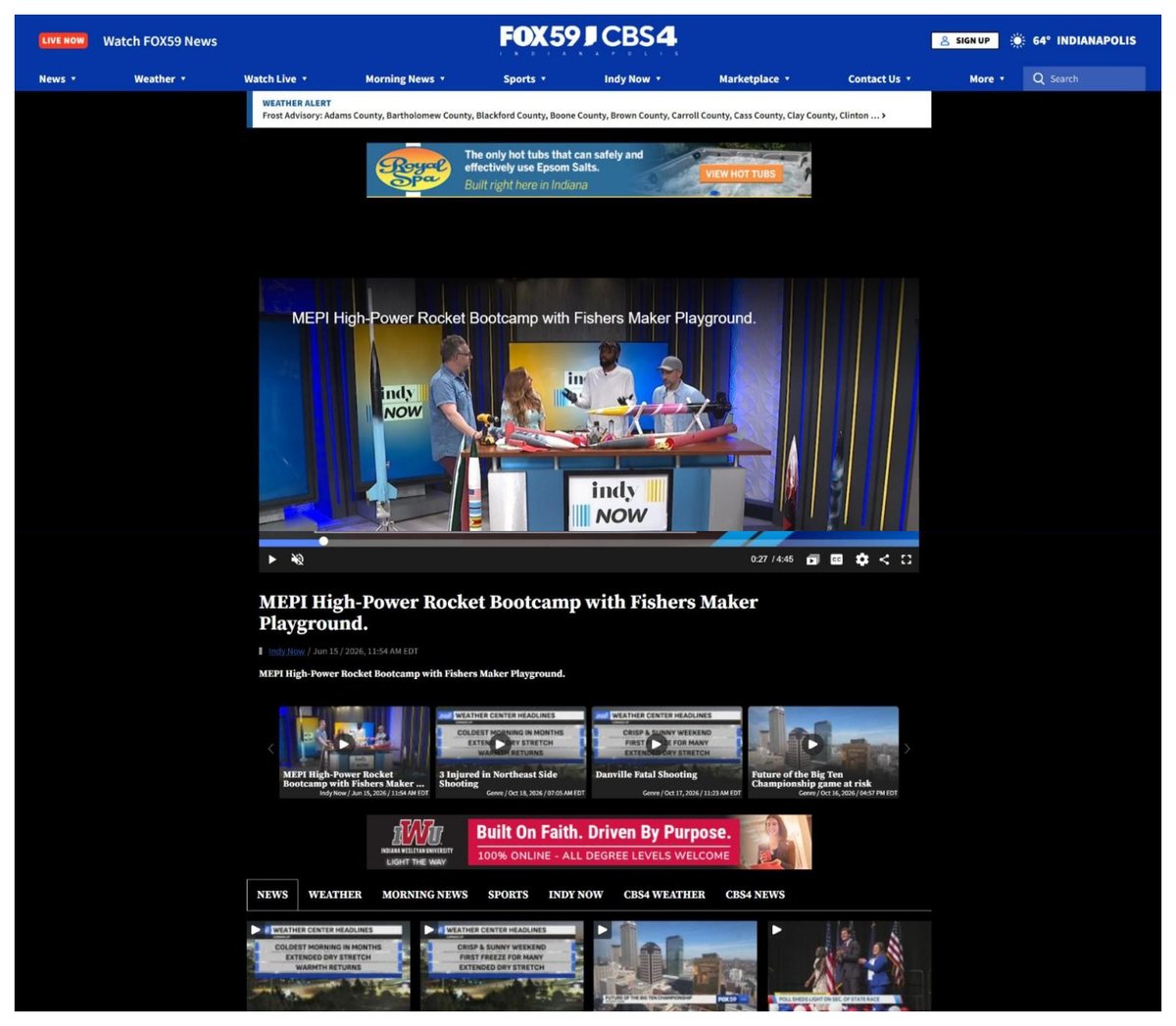
MEPI High-Power Rocket Bootcamp with Fishers Maker Playground. Video segment page on fox59.com (Indy Now). The page carries the video player and the segment title; the segment itself is the live studio appearance with the City of Fishers, cross-aired on CBS4 Indianapolis. The rest of the captured page is Fox59's news rail and site navigation on the capture date. The segment is also on Fox59's YouTube channel (linked below), and the transcript is under "Watch the coverage" at the top of this page.
Live page: fox59.com ↗ · Fox59 on YouTube ↗
Space in Africa: "18-year-old Tanaka Chonyera wants to lead Zimbabwe to space"
Read the text
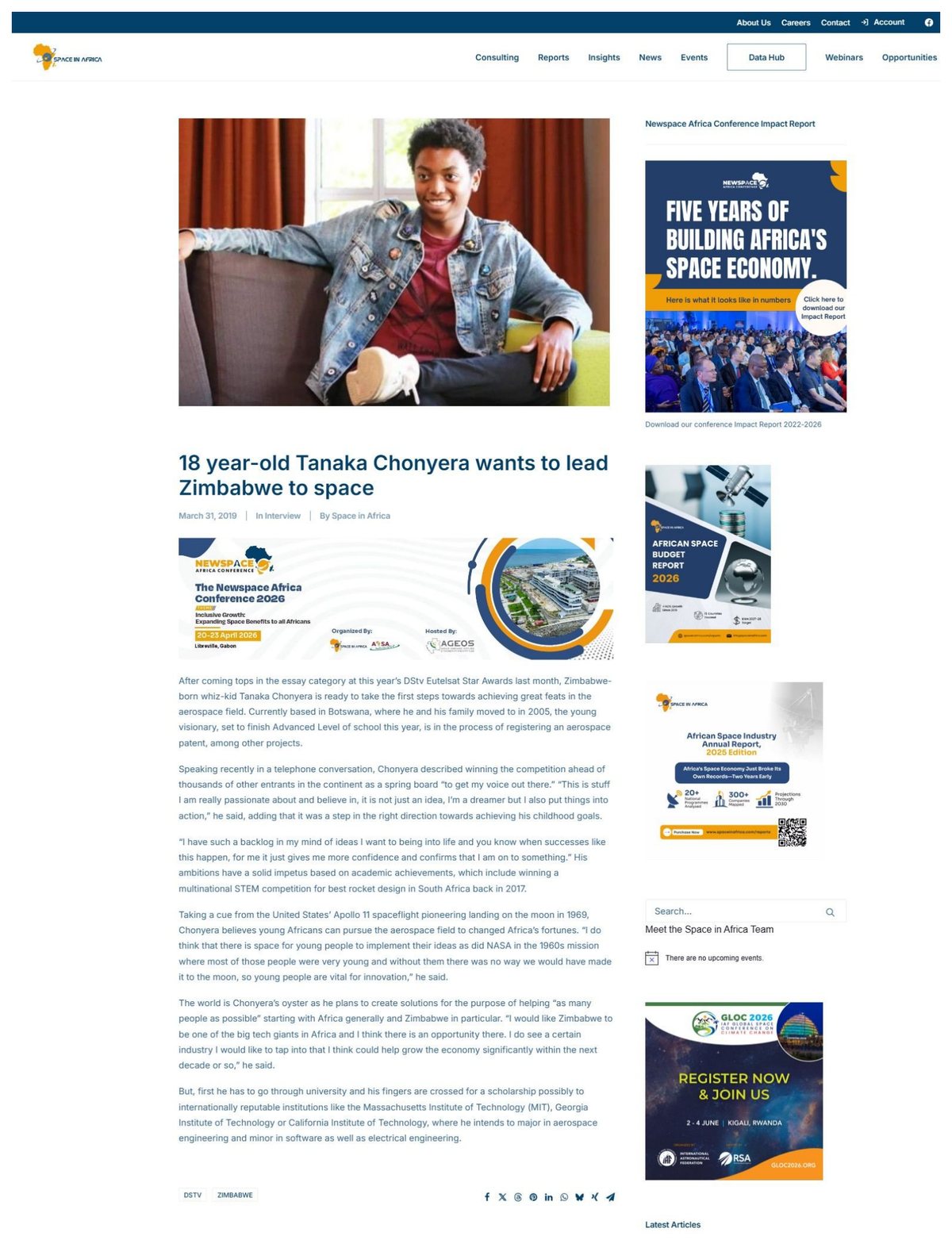
18 year-old Tanaka Chonyera wants to lead Zimbabwe to space
After coming tops in the essay category at this year's DStv Eutelsat Star Awards last month, Zimbabwe-born whiz-kid Tanaka Chonyera is ready to take the first steps towards achieving great feats in the aerospace field. Currently based in Botswana, where he and his family moved to in 2005, the young visionary, set to finish Advanced Level of school this year, is in the process of registering an aerospace patent, among other projects.
Speaking recently in a telephone conversation, Chonyera described winning the competition ahead of thousands of other entrants in the continent as a spring board "to get my voice out there." "This is stuff I am really passionate about and believe in, it is not just an idea, I'm a dreamer but I also put things into action," he said, adding that it was a step in the right direction towards achieving his childhood goals.
"I have such a backlog in my mind of ideas I want to bring into life and you know when successes like this happen, for me it just gives me more confidence and confirms that I am on to something." His ambitions have a solid impetus based on academic achievements, which include winning a multinational STEM competition for best rocket design in South Africa back in 2017.
Taking a cue from the United States' Apollo 11 spaceflight pioneering landing on the moon in 1969, Chonyera believes young Africans can pursue the aerospace field to change Africa's fortunes. "I do think that there is space for young people to implement their ideas as did NASA in the 1960s mission where most of those people were very young and without them there was no way we would have made it to the moon, so young people are vital for innovation," he said.
The world is Chonyera's oyster as he plans to create solutions for the purpose of helping "as many people as possible" starting with Africa generally and Zimbabwe in particular. "I would like Zimbabwe to be one of the big tech giants in Africa and I think there is an opportunity there. I do see a certain industry I would like to tap into that I think could help grow the economy significantly within the next decade or so," he said.
But, first he has to go through university and his fingers are crossed for a scholarship possibly to internationally reputable institutions like the Massachusetts Institute of Technology (MIT), Georgia Institute of Technology or California Institute of Technology, where he intends to major in aerospace engineering and minor in software as well as electrical engineering.
Tags: DStv, Zimbabwe.
Live page: spaceinafrica.com ↗
Eli Lilly and Company, Global Day of Service: the Indiana project card
Read the text
Project card (both platforms): INDIANA. Encouraging careers in STEM. Helping students build and launch high-powered rockets. Project 01 of 210. World map with the Indiana pin highlighted.
Instagram caption: elilillyco: Lilly's Global Day of Service is a tradition that's been going strong for 19 years. Tens of thousands of Lilly team members across the globe are setting out-of-office... (carousel; the Indiana card is image 2; 920 likes, 55 comments, 34 shares, 82 saves at capture).
LinkedIn post: For the past 19 years, Lilly's Global Day of Service has always been about one simple goal: creating meaningful change in the areas where we live and work. Today, tens of thousands of Lilly team members across dozens of countries will step out of their workplaces and into community spaces as they participate in hands-on projects. Check out a few different ways we're making an impact all over the map. #WeAreLilly #LGDOS. Document carousel "Global Day of Service", 8 pages.
Live posts: Instagram ↗ · LinkedIn ↗
Eutelsat's photo of the prize trip: Tanaka at the Guiana Space Center
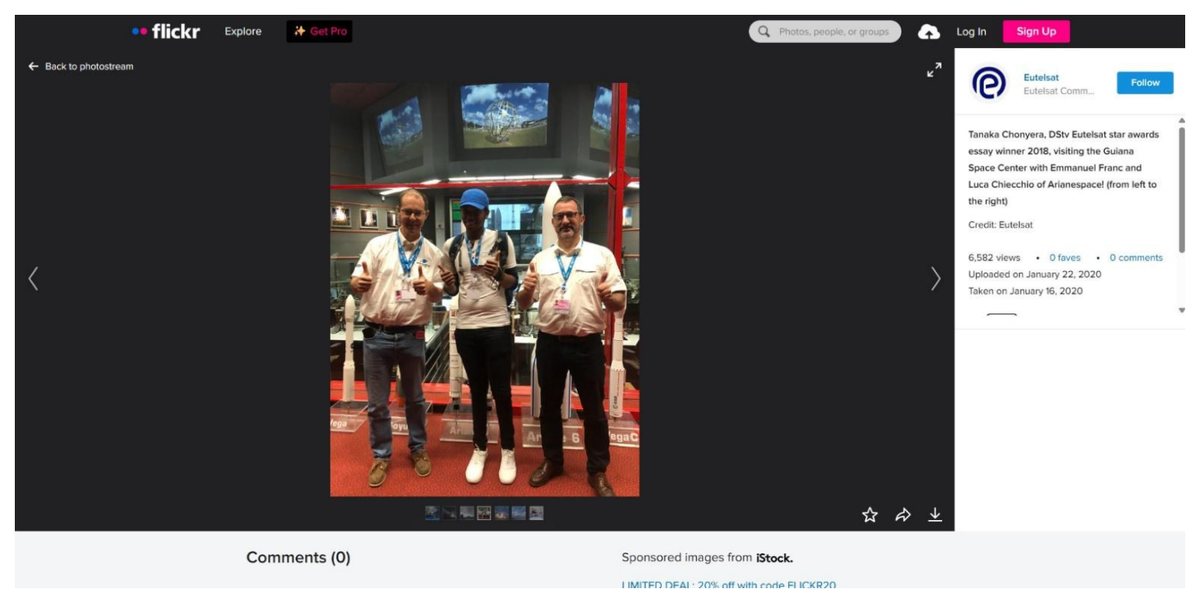
Read the text
"Tanaka Chonyera, DStv Eutelsat star awards essay winner 2018, visiting the Guiana Space Center with Emmanuel Franc and Luca Chiecchio of Arianespace! (from left to the right)". Credit: Eutelsat. Uploaded on January 22, 2020. Taken on January 16, 2020. Posted by the Eutelsat Communications account.
Live page: flickr.com ↗
Indiana State Museum: Rocket Bootcamp event listing, then sold out
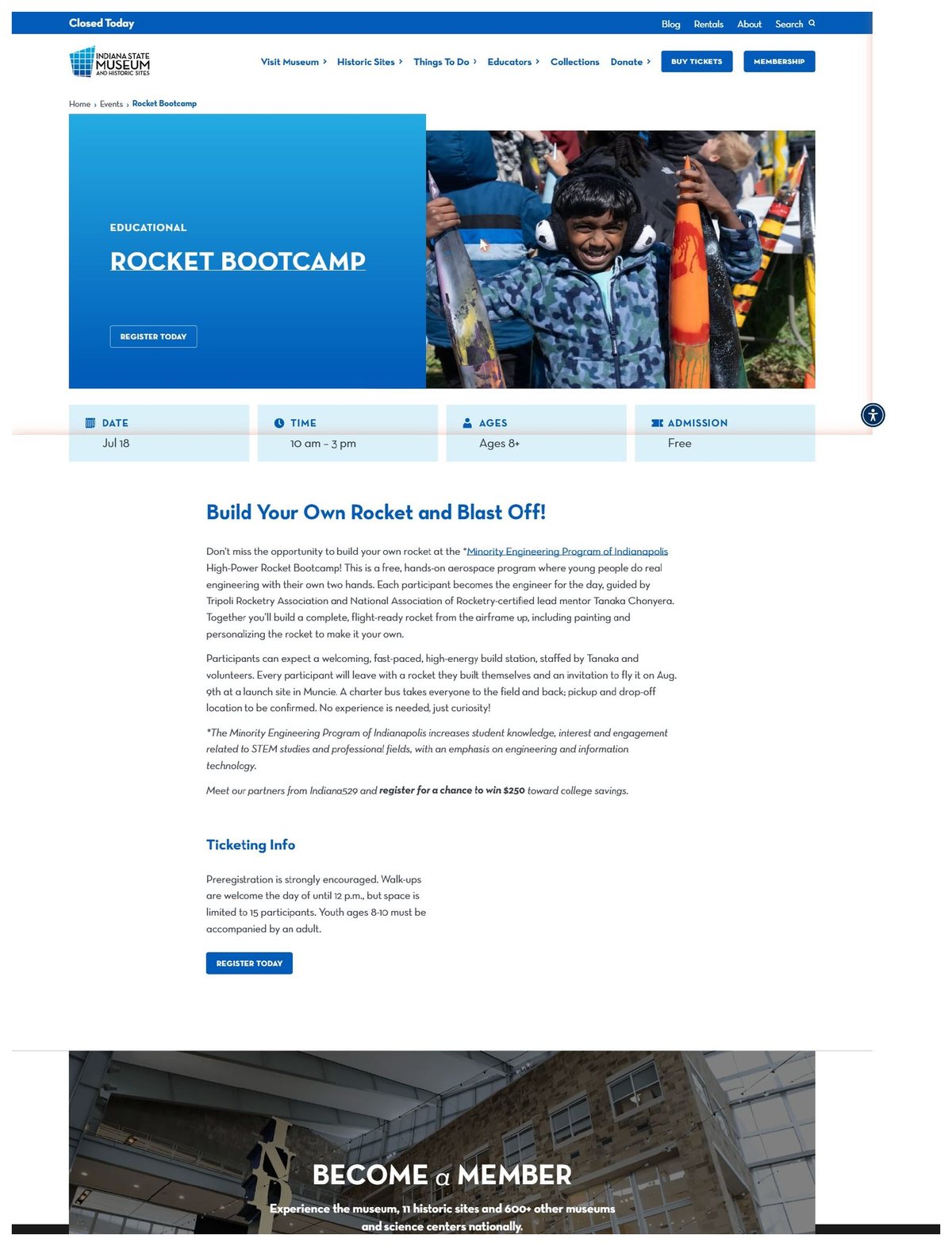
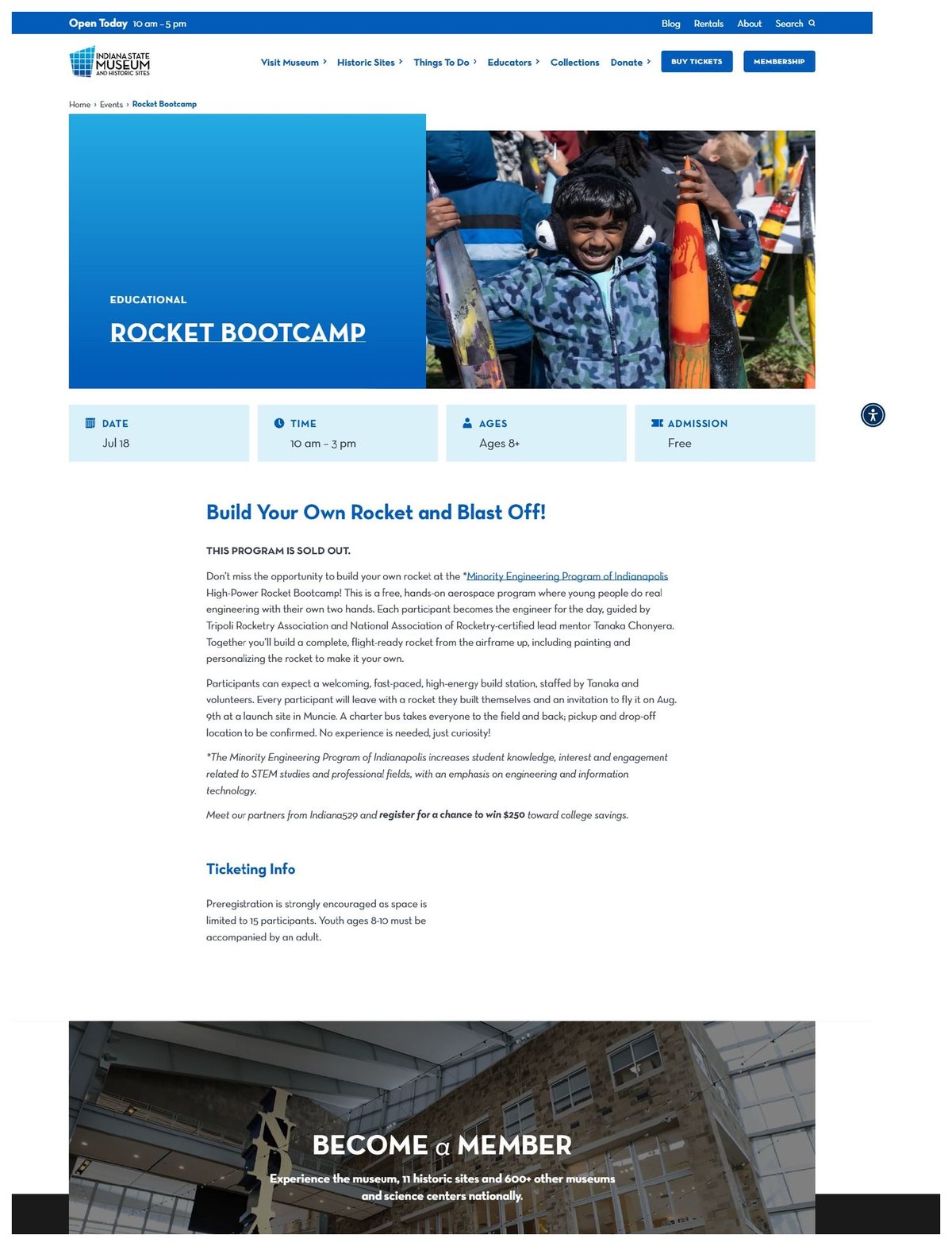
Read the text
Rocket Bootcamp. Date: Jul 18. Time: 10 am to 3 pm. Ages: 8+. Admission: Free. Build Your Own Rocket and Blast Off! (July 16 capture adds: THIS PROGRAM IS SOLD OUT.)
Don't miss the opportunity to build your own rocket at the Minority Engineering Program of Indianapolis High-Power Rocket Bootcamp! This is a free, hands-on aerospace program where young people do real engineering with their own two hands. Each participant becomes the engineer for the day, guided by Tripoli Rocketry Association and National Association of Rocketry-certified lead mentor Tanaka Chonyera. Together you'll build a complete, flight-ready rocket from the airframe up, including painting and personalizing the rocket to make it your own.
Participants can expect a welcoming, fast-paced, high-energy build station, staffed by Tanaka and volunteers. Every participant will leave with a rocket they built themselves and an invitation to fly it on Aug. 9th at a launch site in Muncie. A charter bus takes everyone to the field and back; pickup and drop-off location to be confirmed. No experience is needed, just curiosity!
The Minority Engineering Program of Indianapolis increases student knowledge, interest and engagement related to STEM studies and professional fields, with an emphasis on engineering and information technology. Meet our partners from Indiana529 and register for a chance to win $250 toward college savings.
Ticketing Info. July 14: Preregistration is strongly encouraged. Walk-ups are welcome the day of until 12 p.m., but space is limited to 15 participants. Youth ages 8-10 must be accompanied by an adult. July 16: Preregistration is strongly encouraged as space is limited to 15 participants. Youth ages 8-10 must be accompanied by an adult.
Indiana State Museum and Historic Sites, 650 W. Washington St., Indianapolis, IN 46204. 317.232.1637.
Live page: indianamuseum.org ↗
City of Fishers Maker Playground: High-Power Rocket Bootcamp listing
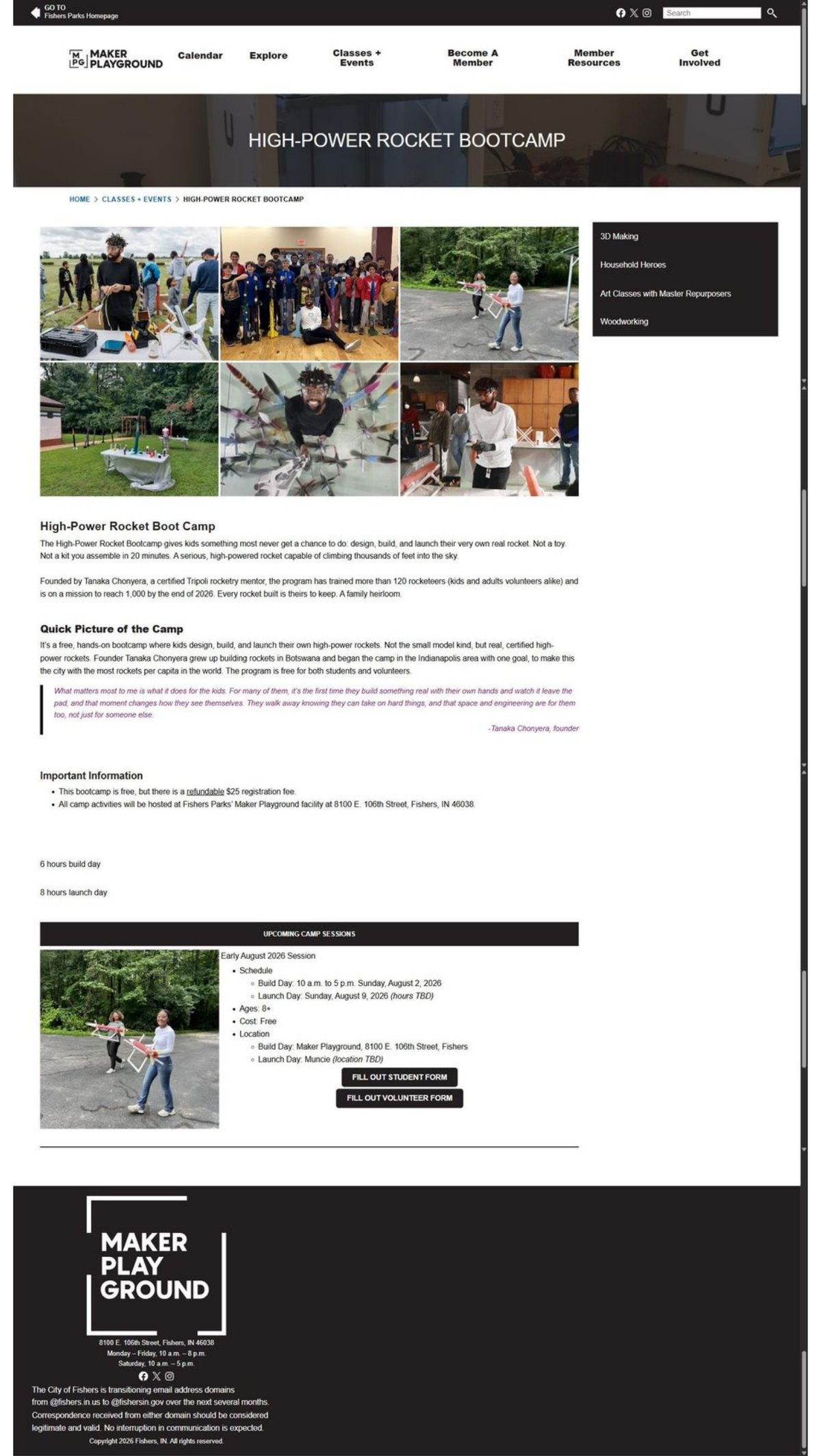
Read the text
High-Power Rocket Boot Camp. The High-Power Rocket Bootcamp gives kids something most never get a chance to do: design, build, and launch their very own real rocket. Not a toy. Not a kit you assemble in 20 minutes. A serious, high-powered rocket capable of climbing thousands of feet into the sky.
Founded by Tanaka Chonyera, a certified Tripoli rocketry mentor, the program has trained more than 120 rocketeers (kids and adult volunteers alike) and is on a mission to reach 1,000 by the end of 2026. Every rocket built is theirs to keep. A family heirloom.
Quick Picture of the Camp. It's a free, hands-on bootcamp where kids design, build, and launch their own high-power rockets. Not the small model kind, but real, certified high-power rockets. Founder Tanaka Chonyera grew up building rockets in Botswana and began the camp in the Indianapolis area with one goal, to make this the city with the most rockets per capita in the world. The program is free for both students and volunteers.
Important Information. This bootcamp is free, but there is a refundable $25 registration fee. All camp activities will be hosted at Fishers Parks' Maker Playground facility at 8100 E. 106th Street, Fishers, IN 46038. 6 hours build day. 8 hours launch day.
Early August 2026 Session. Schedule: Build Day: 10 am to 5 pm, Sunday, August 2, 2026. Launch Day: Sunday, August 9, 2026 (hours TBD). Ages: 8+. Cost: Free. Location: Build Day: Maker Playground, 8100 E. 106th Street, Fishers. Launch Day: Muncie (location TBD). Fill out student form. Fill out volunteer form.
Maker Playground, 8100 E. 106th Street, Fishers, IN. Monday to Friday 10 am to 8 pm, Saturday 10 am to 5 pm.
Live page: fishersmpg.com ↗ · Wayback archive, July 26, 2026 ↗
Profiled in The Week Junior
Read the text
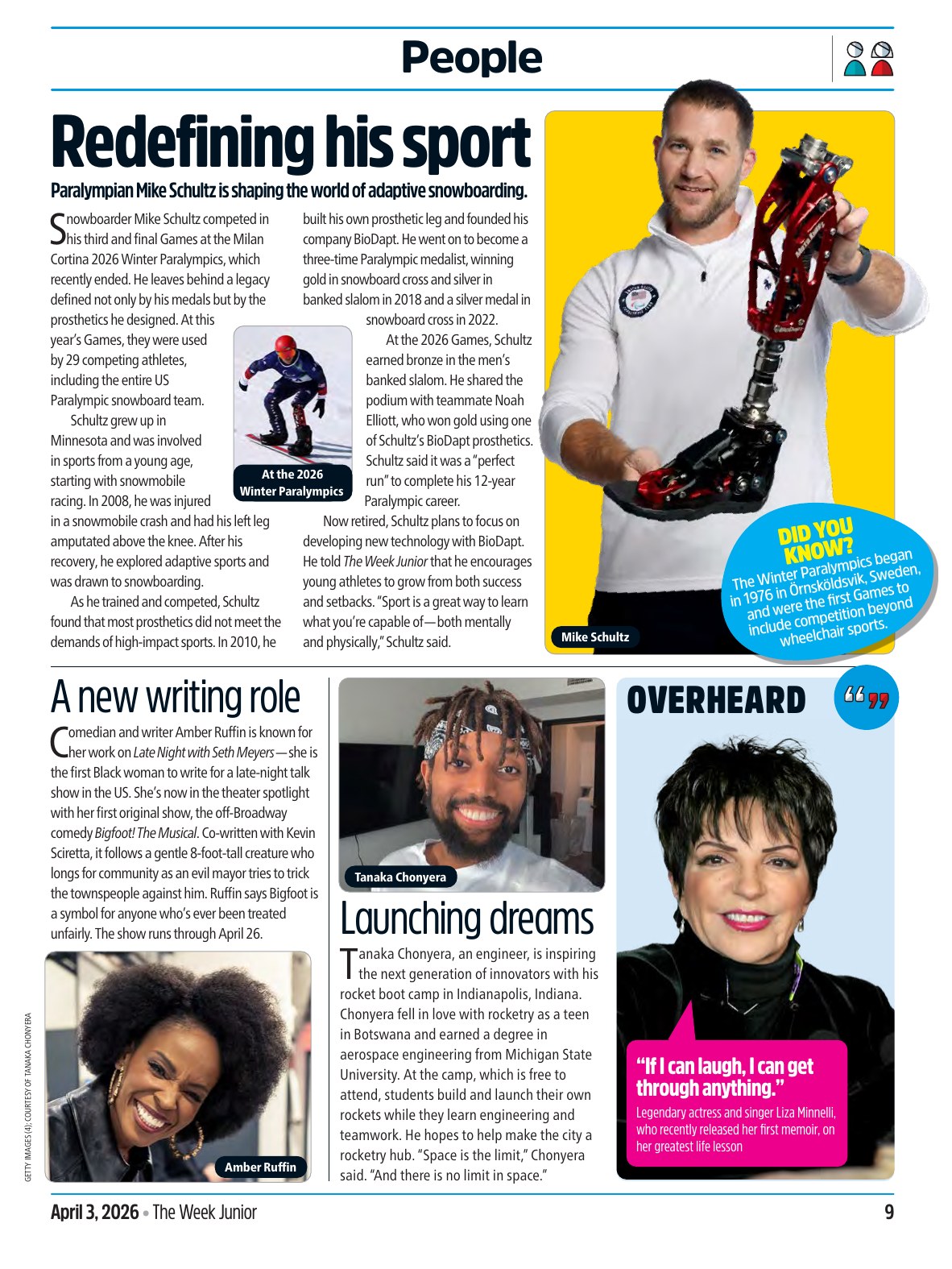
Tanaka Chonyera, an engineer, is inspiring the next generation of innovators with his rocket boot camp in Indianapolis, Indiana. Chonyera fell in love with rocketry as a teen in Botswana and earned a degree in aerospace engineering from Michigan State University. At the camp, which is free to attend, students build and launch their own rockets while they learn engineering and teamwork. He hopes to help make the city a rocketry hub. "Space is the limit," Chonyera said. "And there is no limit in space."
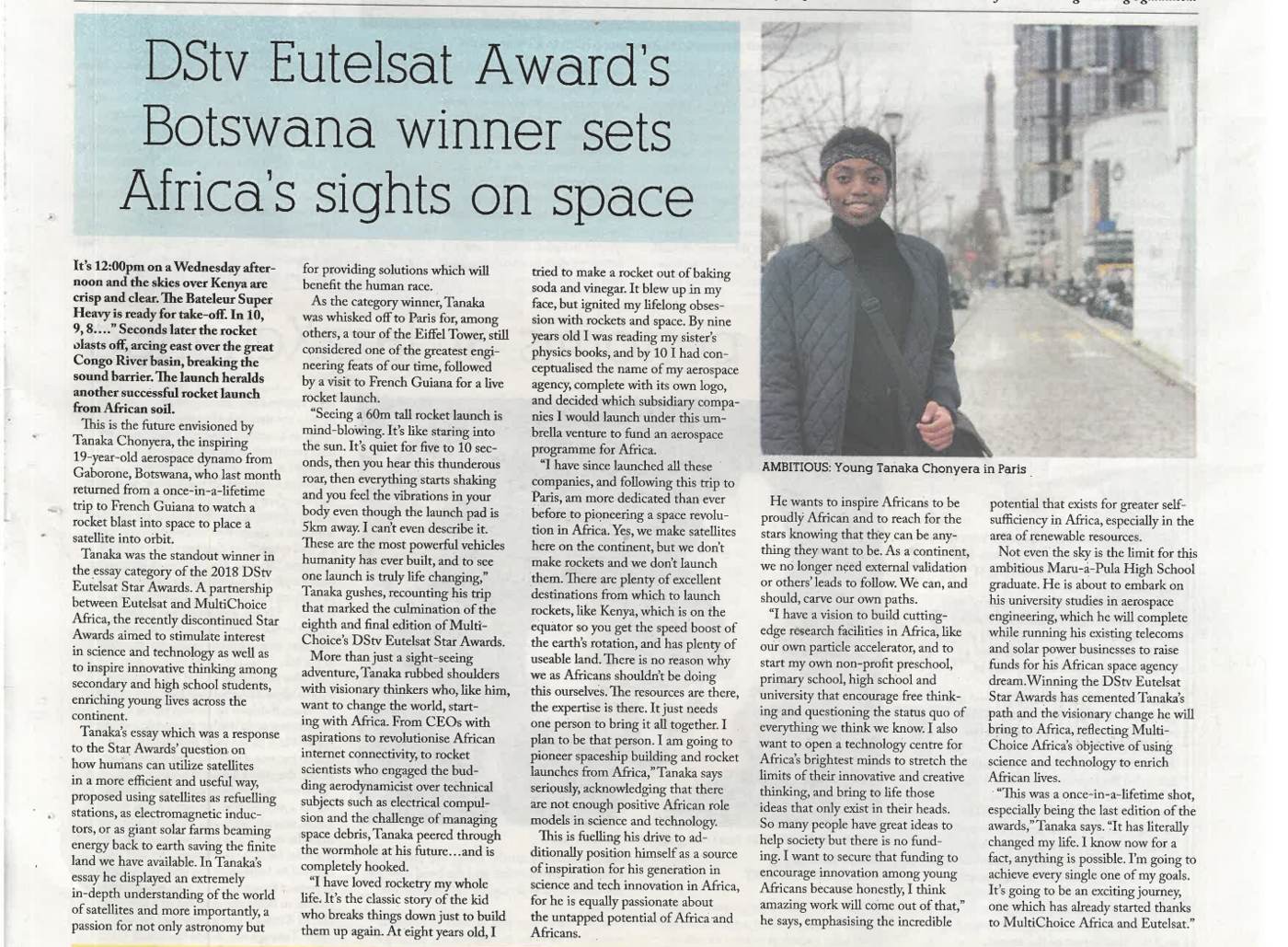
DStv Eutelsat Award's Botswana winner sets Africa's sights on space
Read the text
"It's 12:00pm on a Wednesday afternoon and the skies over Kenya are crisp and clear. The Bateleur Super Heavy is ready for take-off. In 10, 9, 8...." Seconds later the rocket blasts off, arcing east over the great Congo River basin, breaking the sound barrier. The launch heralds another successful rocket launch from African soil.
This is the future envisioned by Tanaka Chonyera, the inspiring 19-year-old aerospace dynamo from Gaborone, Botswana, who last month returned from a once-in-a-lifetime trip to French Guiana to watch a rocket blast into space to place a satellite into orbit.
Tanaka was the standout winner in the essay category of the 2018 DStv Eutelsat Star Awards. A partnership between Eutelsat and MultiChoice Africa, the recently discontinued Star Awards aimed to stimulate interest in science and technology as well as to inspire innovative thinking among secondary and high school students, enriching young lives across the continent.
Tanaka's essay which was a response to the Star Awards' question on how humans can utilize satellites in a more efficient and useful way, proposed using satellites as refuelling stations, as electromagnetic inductors, or as giant solar farms beaming energy back to earth saving the finite land we have available. In Tanaka's essay he displayed an extremely in-depth understanding of the world of satellites and more importantly, a passion for not only astronomy but for providing solutions which will benefit the human race.
As the category winner, Tanaka was whisked off to Paris for, among others, a tour of the Eiffel Tower, still considered one of the greatest engineering feats of our time, followed by a visit to French Guiana for a live rocket launch.
"Seeing a 60m tall rocket launch is mind-blowing. It's like staring into the sun. It's quiet for five to 10 seconds, then you hear this thunderous roar, then everything starts shaking and you feel the vibrations in your body even though the launch pad is 5km away. I can't even describe it. These are the most powerful vehicles humanity has ever built, and to see one launch is truly life changing," Tanaka gushes, recounting his trip that marked the culmination of the eighth and final edition of MultiChoice's DStv Eutelsat Star Awards.
More than just a sight-seeing adventure, Tanaka rubbed shoulders with visionary thinkers who, like him, want to change the world, starting with Africa. From CEOs with aspirations to revolutionise African internet connectivity, to rocket scientists who engaged the budding aerodynamicist over technical subjects such as electrical compulsion and the challenge of managing space debris, Tanaka peered through the wormhole at his future... and is completely hooked.
"I have loved rocketry my whole life. It's the classic story of the kid who breaks things down just to build them up again. At eight years old, I tried to make a rocket out of baking soda and vinegar. It blew up in my face, but ignited my lifelong obsession with rockets and space. By nine years old I was reading my sister's physics books, and by 10 I had conceptualised the name of my aerospace agency, complete with its own logo, and decided which subsidiary companies I would launch under this umbrella venture to fund an aerospace programme for Africa.
"I have since launched all these companies, and following this trip to Paris, am more dedicated than ever before to pioneering a space revolution in Africa. Yes, we make satellites here on the continent, but we don't make rockets and we don't launch them. There are plenty of excellent destinations from which to launch rockets, like Kenya, which is on the equator so you get the speed boost of the earth's rotation, and has plenty of useable land. There is no reason why we as Africans shouldn't be doing this ourselves. The resources are there, the expertise is there. It just needs one person to bring it all together. I plan to be that person. I am going to pioneer spaceship building and rocket launches from Africa," Tanaka says seriously, acknowledging that there are not enough positive African role models in science and technology.
This is fuelling his drive to additionally position himself as a source of inspiration for his generation in science and tech innovation in Africa, for he is equally passionate about the untapped potential of Africa and Africans.
He wants to inspire Africans to be proudly African and to reach for the stars knowing that they can be anything they want to be. As a continent, we no longer need external validation or others' leads to follow. We can, and should, carve our own paths.
"I have a vision to build cutting-edge research facilities in Africa, like our own particle accelerator, and to start my own non-profit preschool, primary school, high school and university that encourage free thinking and questioning the status quo of everything we think we know. I also want to open a technology centre for Africa's brightest minds to stretch the limits of their innovative and creative thinking, and bring to life those ideas that only exist in their heads. So many people have great ideas to help society but there is no funding. I want to secure that funding to encourage innovation among young Africans because honestly, I think amazing work will come out of that," he says, emphasising the incredible potential that exists for greater self-sufficiency in Africa, especially in the area of renewable resources.
Not even the sky is the limit for this ambitious Maru-a-Pula High School graduate. He is about to embark on his university studies in aerospace engineering, which he will complete while running his existing telecoms and solar power businesses to raise funds for his African space agency dream. Winning the DStv Eutelsat Star Awards has cemented Tanaka's path and the visionary change he will bring to Africa, reflecting MultiChoice Africa's objective of using science and technology to enrich African lives.
"This was a once-in-a-lifetime shot, especially being the last edition of the awards," Tanaka says. "It has literally changed my life. I know now for a fact, anything is possible. I'm going to achieve every single one of my goals. It's going to be an exciting journey, one which has already started thanks to MultiChoice Africa and Eutelsat."
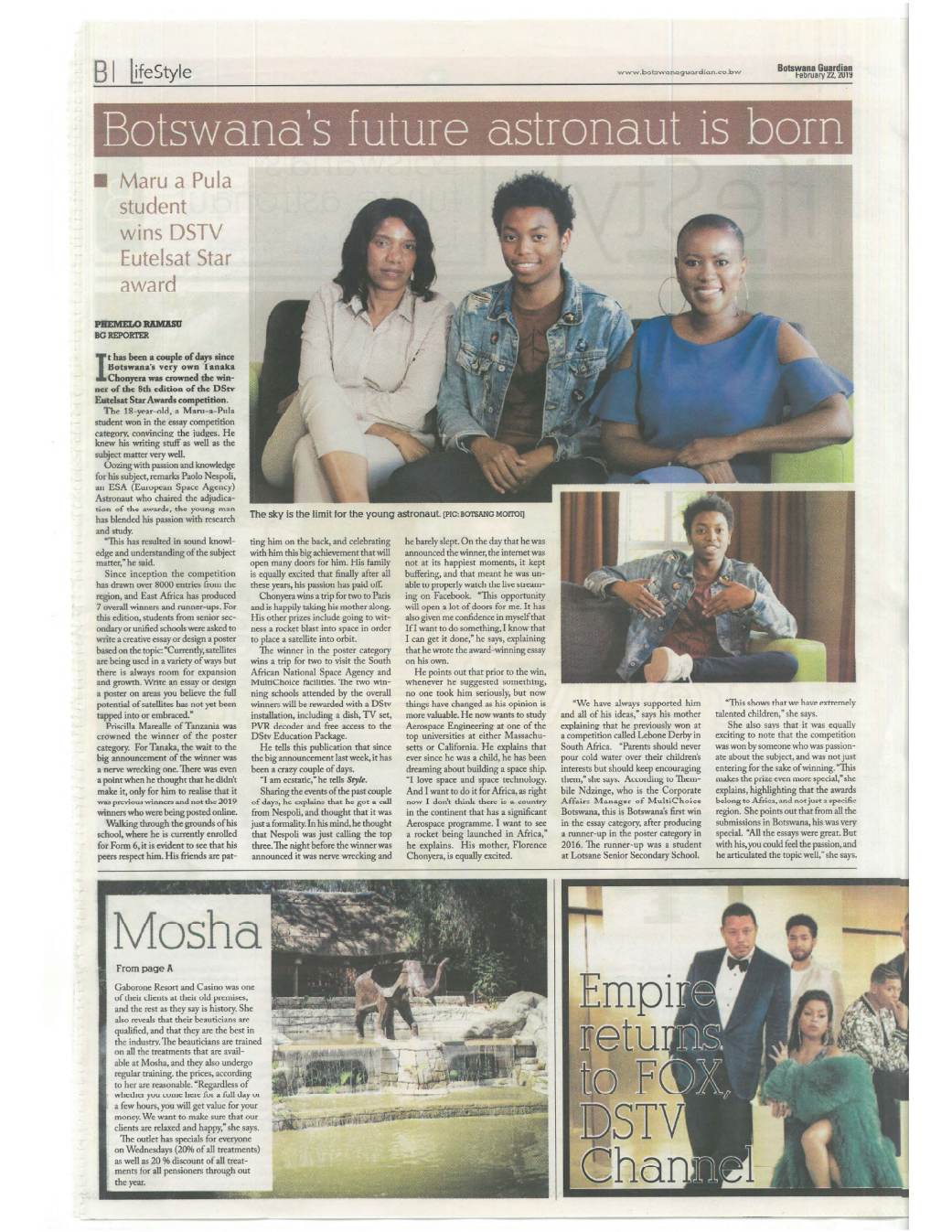
Botswana's Future Astronaut is Born
Read the text
It has been a couple of days since Botswana's very own Tanaka Chonyera was crowned the winner of the 8th edition of the DStv Eutelsat Star Awards competition.
The 18-year-old, a Maru-a-Pula student won in the essay competition category, convincing the judges. He knew his writing stuff as well as the subject matter very well.
Oozing with passion and knowledge for his subject, remarks Paolo Nespoli, an ESA (European Space Agency) Astronaut who chaired the adjudication of the awards, the young man has blended his passion with research and study.
"This has resulted in sound knowledge and understanding of the subject matter," he said.
Since inception the competition has drawn over 8000 entries from the region, and East Africa has produced 7 overall winners and runner-ups. For this edition, students from senior secondary or unified schools were asked to write a creative essay or design a poster based on the topic: "Currently, satellites are being used in a variety of ways but there is always room for expansion and growth. Write an essay or design a poster on areas you believe the full potential of satellites has not yet been tapped into or embraced."
Priscilla Marealle of Tanzania was crowned the winner of the poster category. For Tanaka, the wait to the big announcement of the winner was a nerve wrecking one. There was even a point when he thought that he didn't make it, only for him to realise that it was previous winners and not the 2019 winners who were being posted online.
Walking through the grounds of his school, where he is currently enrolled for Form 6, it is evident to see that his peers respect him. His friends are patting him on the back, and celebrating with him this big achievement that will open many doors for him. His family is equally excited that finally after all these years, his passion has paid off.
Chonyera wins a trip for two to Paris and is happily taking his mother along. His other prizes include going to witness a rocket blast into space in order to place a satellite into orbit.
The winner in the poster category wins a trip for two to visit the South African National Space Agency and MultiChoice facilities. The two winning schools attended by the overall winners will be rewarded with a DStv installation, including a dish, TV set, PVR decoder and free access to the DStv Education Package.
He tells this publication that since the big announcement last week, it has been a crazy couple of days.
"I am ecstatic," he tells Style.
Sharing the events of the past couple of days, he explains that he got a call from Nespoli, and thought that it was just a formality. In his mind, he thought that Nespoli was just calling the top three. The night before the winner was announced it was nerve wrecking and he barely slept. On the day that he was announced the winner, the internet was not at its happiest moments, it kept buffering, and that meant he was unable to properly watch the live streaming on Facebook. "This opportunity will open a lot of doors for me. It has also given me confidence in myself that if I want to do something, I know that I can get it done," he says, explaining that he wrote the award-winning essay on his own.
He points out that prior to the win, whenever he suggested something, no one took him seriously, but now things have changed as his opinion is more valuable. He now wants to study Aerospace Engineering at one of the top universities at either Massachusetts or California. He explains that ever since he was a child, he has been dreaming about building a space ship. "I love space and space technology. And I want to do it for Africa, as right now I don't think there is a country in the continent that has a significant Aerospace programme. I want to see a rocket being launched in Africa," he explains. His mother, Florence Chonyera, is equally excited.
"We have always supported him and all of his ideas," says his mother explaining that he previously won at a competition called Lebone Derby in South Africa. "Parents should never pour cold water over their children's interests but should keep encouraging them," she says. According to Thembile Ndzinge, who is the Corporate Affairs Manager of MultiChoice Botswana, this is Botswana's first win in the essay category, after producing a runner-up in the poster category in 2016. The runner-up was a student at Lotsane Senior Secondary School.
"This shows that we have extremely talented children," she says.
She also says that it was equally exciting to note that the competition was won by someone who was passionate about the subject, and was not just entering for the sake of winning. "This makes the prize even more special," she explains, highlighting that the awards belong to Africa, and not just a specific region. She points out that from all the submissions in Botswana, his was very special. "All the essays were great. But with his, you could feel the passion, and he articulated the topic well," she says.
High Voltage Divider Feature
Read the text
The Greensheet. March 25, 2022, Volume 43, Number 10. Facility for Rare Isotope Beams, Michigan State University.
Stable HV System for Laser Spectroscopy Measurements. Contributed by Adam Dockery, Tanaka Chonyera, Kristian König, Kei Minamisono.
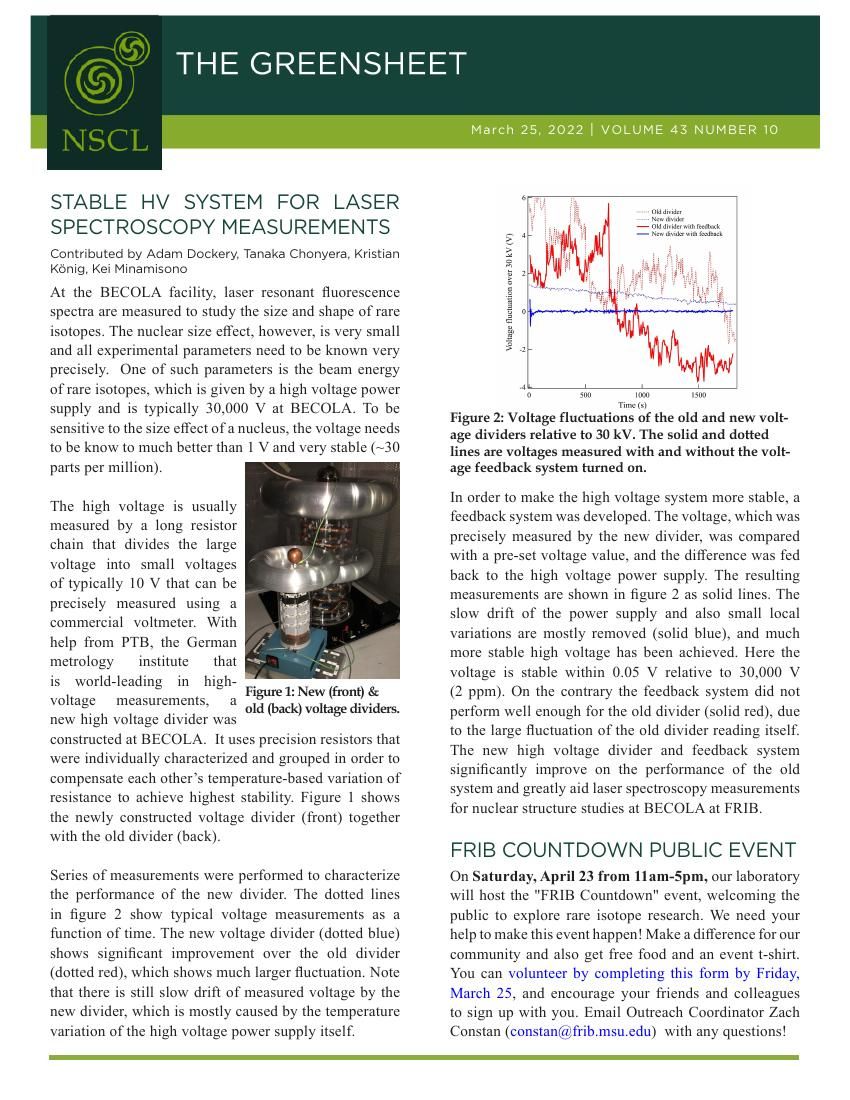
At the BECOLA facility, laser resonant fluorescence spectra are measured to study the size and shape of rare isotopes. The nuclear size effect, however, is very small and all experimental parameters need to be known very precisely. One of such parameters is the beam energy of rare isotopes, which is given by a high voltage power supply and is typically 30,000 V at BECOLA. To be sensitive to the size effect of a nucleus, the voltage needs to be known to much better than 1 V and very stable (~30 parts per million).
The high voltage is usually measured by a long resistor chain that divides the large voltage into small voltages of typically 10 V that can be precisely measured using a commercial voltmeter. With help from PTB, the German metrology institute that is world-leading in high-voltage measurements, a new high voltage divider was constructed at BECOLA. It uses precision resistors that were individually characterized and grouped in order to compensate each other's temperature-based variation of resistance to achieve highest stability. Figure 1 shows the newly constructed voltage divider (front) together with the old divider (back).
Series of measurements were performed to characterize the performance of the new divider. The dotted lines in figure 2 show typical voltage measurements as a function of time. The new voltage divider (dotted blue) shows significant improvement over the old divider (dotted red), which shows much larger fluctuation. Note that there is still slow drift of measured voltage by the new divider, which is mostly caused by the temperature variation of the high voltage power supply itself.
In order to make the high voltage system more stable, a feedback system was developed. The voltage, which was precisely measured by the new divider, was compared with a pre-set voltage value, and the difference was fed back to the high voltage power supply. The resulting measurements are shown in figure 2 as solid lines. The slow drift of the power supply and also small local variations are mostly removed (solid blue), and much more stable high voltage has been achieved. Here the voltage is stable within 0.05 V relative to 30,000 V (2 ppm). On the contrary the feedback system did not perform well enough for the old divider (solid red), due to the large fluctuation of the old divider reading itself. The new high voltage divider and feedback system significantly improve on the performance of the old system and greatly aid laser spectroscopy measurements for nuclear structure studies at BECOLA at FRIB.
Figure 1: New (front) and old (back) voltage dividers. Figure 2: Voltage fluctuations of the old and new voltage dividers relative to 30 kV. The solid and dotted lines are voltages measured with and without the voltage feedback system turned on.
FRIB Countdown Public Event. On Saturday, April 23 from 11am-5pm, our laboratory will host the "FRIB Countdown" event, welcoming the public to explore rare isotope research. We need your help to make this event happen! Make a difference for our community and also get free food and an event t-shirt. You can volunteer by completing this form by Friday, March 25, and encourage your friends and colleagues to sign up with you. Email Outreach Coordinator Zach Constan ([email protected]) with any questions!
Photo Contest Winners. Contributed by Zach Constan. The FRIB Outreach Committee is excited to announce the winners of the "What FRIB Means To Me" photo contest, as selected by your votes! Congratulations to the winners, who will receive cash prizes and have their framed photos exhibited in the space outside of 1300 Auditorium. Many other excellent submissions have been selected as honorable mentions and will also be part of the exhibit. Please help us celebrate the contest winners at an awards ceremony in the 1300 Auditorium at noon on Friday, April 1. FRIB Photo Contest 1st place: Phil Morrison, "RFQ Power Coupler Port". 2nd place (tie): Shumpei Noji, "Ten GRETINA Quad Detector Modules at the S800 Entrance"; Kyle Godbey, "Collision".
Flammable Liquids. Contributed by Becky DeZess-Smith. Improper storage and handling of flammable chemicals, and failure to recognize and control ignition sources, have accounted for many industrial accidents involving flammable liquid use. Statistics indicate that more than 20% of industrial fires and 15% of office fires start with the ignition of a flammable or combustible liquid. A combustible substance is one that catches fire and burns easily. A flammable substance is one that continues to burn even after the ignition source is removed. Flammable liquids burn with intensity. This accounts for the rapid heat buildup and how fast the fire spreads. It is important to realize that the liquid itself does not burn, but its vapors, which are invisible and generally heavier than air, burn. Always consult the safety data sheet (SDS) provided by the manufacturer to determine the flammability of a particular liquid. When storing or working with flammable liquids, take precautions to eliminate ignition sources, including open flame, electrical switches, open motors, static electricity, friction and mechanical sparks, heat guns, cutting and welding and radiant heat. Consider: what flammable liquids are you using or storing? Are there any ignition sources around? Take a moment to inspect your work area and ensure all flammable liquids are properly labeled and stored. Any questions regarding the proper labeling or storage of flammable liquids should be directed to the Safety Office.
ReA Update. Contributed by Antonio Villari. This week, ReA3 is delivering silicon-32, silicon-28 and silicon-30 for an experiment on the general purpose beam line in ReA3. All beams are being produced by two batch mode ion sources (BMIS), one for silicon-32 and another for silicon-28 and 30. About five beam energies per isotope are being prepared and delivered to the experiment, which will run until Wednesday, 3/30.
Seminars. Friday, Mar 25, at 5:00 PM: Women Making Science Event, Molecular Plant Sciences Rm 1200. Dr. Gemma Reguera, MSU Microbiology; Dr. Kaitlyn Cook, MSU Physics; Dr. Emily Josephs, MSU Plant Biology. Wednesday, Mar 30 at 4:10 PM: Women and Minorities Lecture Series, 1300 Auditorium and Zoom. Arlene Modeste Knowles, American Institute of Physics, "The TEAM-UP Report and Supporting African American Physics & Astronomy Students".
National Superconducting Cyclotron Laboratory, Michigan State University, 640 S. Shaw Lane, East Lansing, Michigan 48824-1321. Phone 517-355-9671. www.nscl.msu.edu. Operation of NSCL as a national user facility is supported by the Experimental Nuclear Physics Program of the U.S. National Science Foundation.
DStv Eutelsat Star Awards (2019)
The documents behind the award: the organizer's press release, the competition website naming the winner (archived before the site went offline), the prize terms, the school's announcement, and trade coverage. The page shows a cropped view of each capture; Open and Download give you the full original capture as a searchable PDF, with the source and archive links underneath.
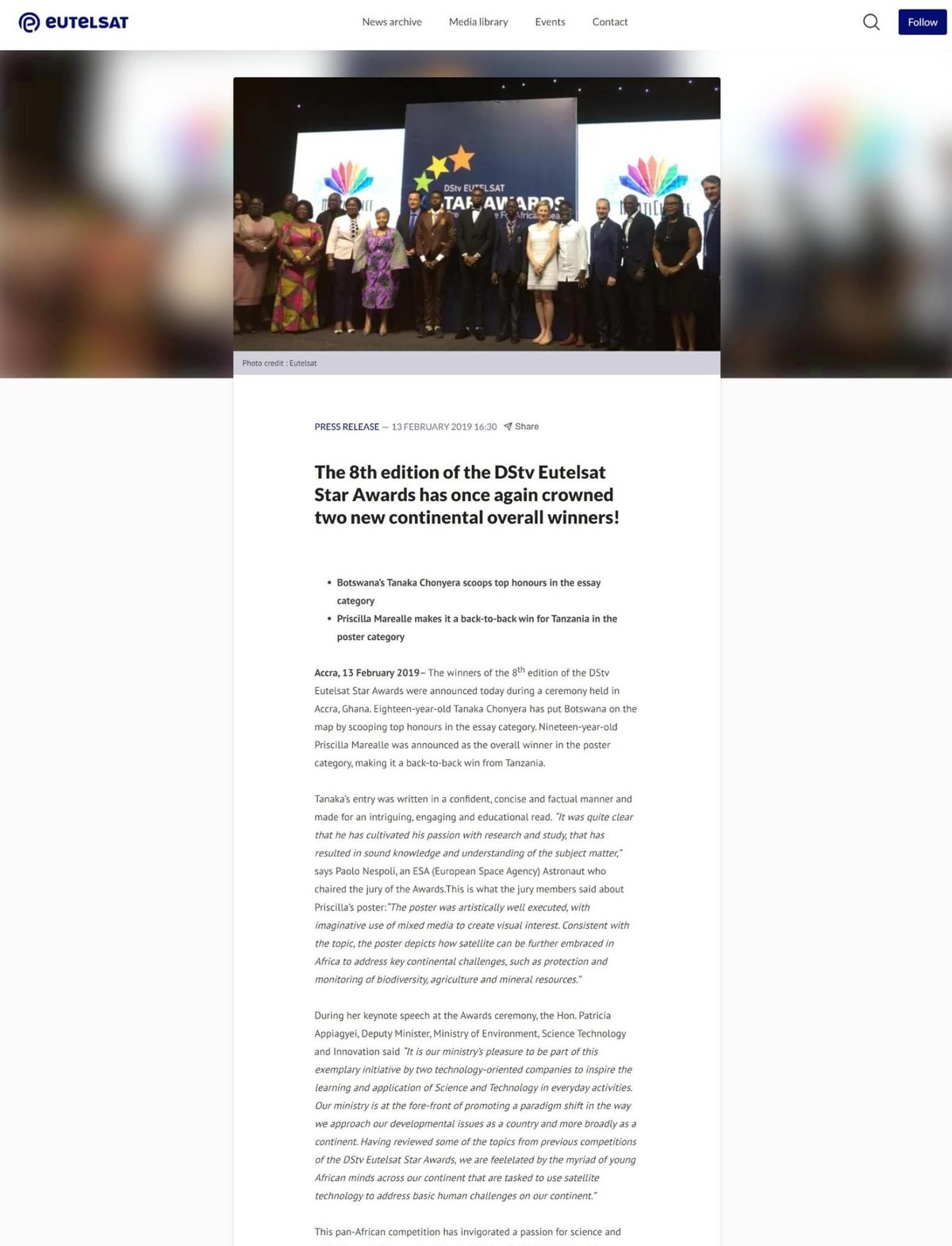
Eutelsat press release: "The 8th edition of the DStv Eutelsat Star Awards has once again crowned two new continental overall winners!"
Read the text
The 8th edition of the DStv Eutelsat Star Awards has once again crowned two new continental overall winners!
Botswana's Tanaka Chonyera scoops top honours in the essay category. Priscilla Marealle makes it a back-to-back win for Tanzania in the poster category.
Accra, 13 February 2019. The winners of the 8th edition of the DStv Eutelsat Star Awards were announced today during a ceremony held in Accra, Ghana. Eighteen-year-old Tanaka Chonyera has put Botswana on the map by scooping top honours in the essay category. Nineteen-year-old Priscilla Marealle was announced as the overall winner in the poster category, making it a back-to-back win from Tanzania.
Tanaka's entry was written in a confident, concise and factual manner and made for an intriguing, engaging and educational read. "It was quite clear that he has cultivated his passion with research and study, that has resulted in sound knowledge and understanding of the subject matter," says Paolo Nespoli, an ESA (European Space Agency) Astronaut who chaired the jury of the Awards. This is what the jury members said about Priscilla's poster: "The poster was artistically well executed, with imaginative use of mixed media to create visual interest. Consistent with the topic, the poster depicts how satellite can be further embraced in Africa to address key continental challenges, such as protection and monitoring of biodiversity, agriculture and mineral resources."
During her keynote speech at the Awards ceremony, the Hon. Patricia Appiagyei, Deputy Minister, Ministry of Environment, Science Technology and Innovation said "It is our ministry's pleasure to be part of this exemplary initiative by two technology-oriented companies to inspire the learning and application of Science and Technology in everyday activities. Our ministry is at the fore-front of promoting a paradigm shift in the way we approach our developmental issues as a country and more broadly as a continent. Having reviewed some of the topics from previous competitions of the DStv Eutelsat Star Awards, we are elated by the myriad of young African minds across our continent that are tasked to use satellite technology to address basic human challenges on our continent."
This pan-African competition has invigorated a passion for science and technology amongst younger generations and will culminate with an outreach where over 200 Ghanaian students have an opportunity to ask a real-life astronaut questions about outer space. To date the competition has drawn over 8000 entries across the continent and has over the years created meaningful engagement with students, the academic community and the scientific world. Sixteen overall winners' horizons have been broadened by the once-in-a-lifetime experiences the competition has afforded them.
The winner in the essay category has won a trip for two to Paris and onwards to a launch site in French Guiana to witness a rocket blast into space in order to place a satellite into orbit. This is Botswana's first win in the essay category, after producing a runner-up in the poster category in 2016. East Africa continues its dominance of the Awards with 7 overall winners and runner-ups thus far. The winner in the poster category has won a trip for two to visit the South African National Space Agency and MultiChoice facilities. The two winning schools attended by the overall winners will be rewarded with a DStv installation, including dish, TV set, PVR decoder and free access to the DStv Education Package.
For this edition, students from secondary (high) or combined schools were asked to write a creative essay or design a poster based on the topic: "Currently, satellites are being used in a variety of ways but there is always room for expansion and growth. Write an essay or design a poster on areas you believe the full potential of satellites has not yet been tapped into or embraced."
All details on the judging criteria, national prizes and finalists' selection are available on the DStv Eutelsat Star Awards website: http://www.dstvstarawards.com/about.html. Join our Facebook community and get exclusive updates and inspiration: fb.me/DStvEutelsatStarAwards.
Topics: Telecom; Radio, TV; Electronic business, communication; Innovations, inventions; Network products; Telecommunication, mobile telephony.
About MultiChoice Africa: MultiChoice Africa is a video entertainment provider, and our role is to enrich lives. Our mission is to deliver value to our customers by making great entertainment more accessible to millions of people across Africa, anytime, anywhere via multiple platforms including Direct-To-Home satellite (DTH) platform DStv (www.dstv.com), a Digital Terrestrial Television (DTT) platform GOtv (www.gotvafrica.com) as well as Video-On-Demand and OTT platforms Showmax and DStv Now. (Boilerplate continues on the Eutelsat page.)
Source: Eutelsat newsroom, original release ↗ · Related: Eutelsat's photo of Tanaka at the Guiana Space Center, January 16, 2020 ↗
Space in Africa: "Botswana and Tanzania students win DStv Eutelsat Star Award"
Read the text
Botswana and Tanzania students win DStv Eutelsat Star Award
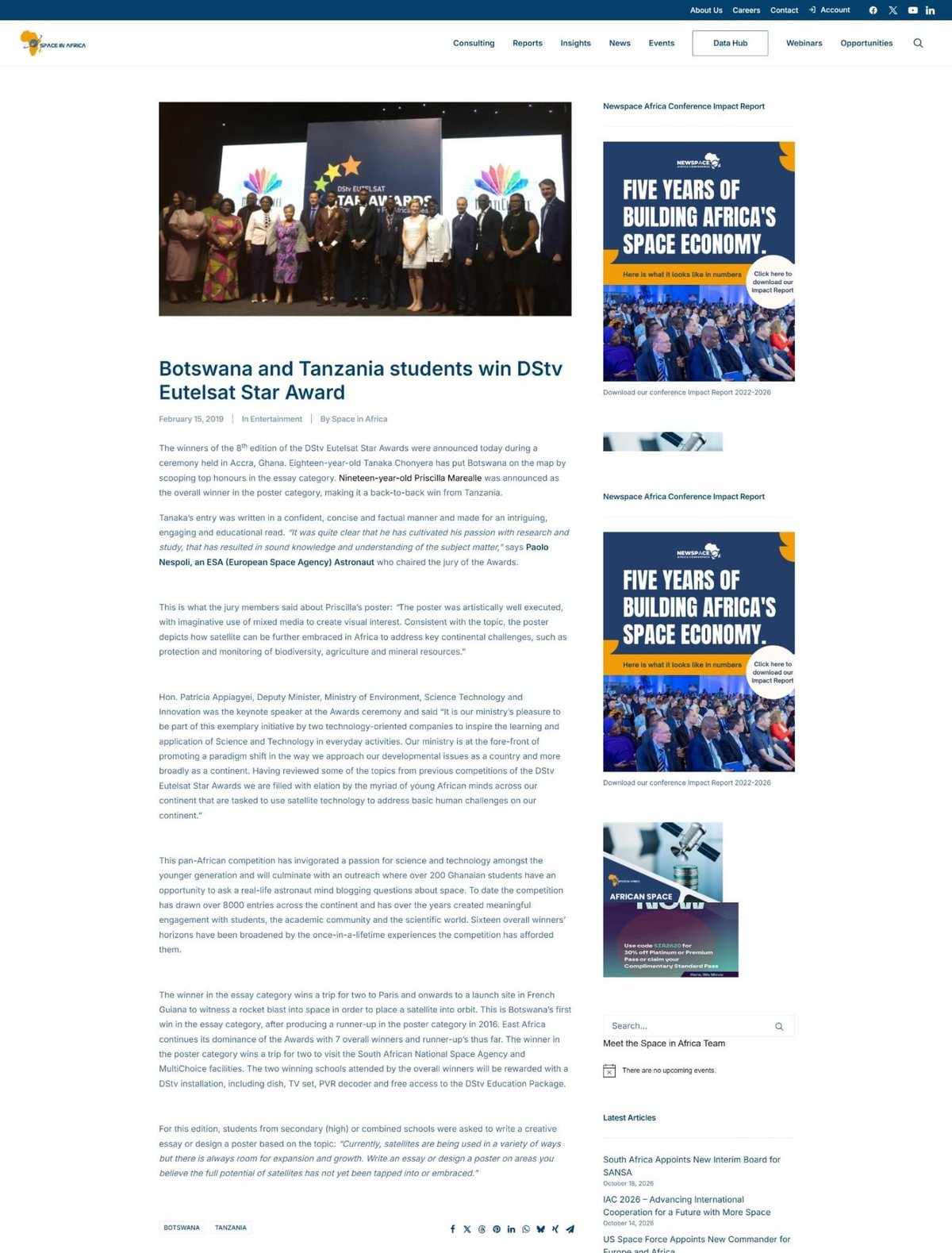
The winners of the 8th edition of the DStv Eutelsat Star Awards were announced today during a ceremony held in Accra, Ghana. Eighteen-year-old Tanaka Chonyera has put Botswana on the map by scooping top honours in the essay category. Nineteen-year-old Priscilla Marealle was announced as the overall winner in the poster category, making it a back-to-back win from Tanzania.
Tanaka's entry was written in a confident, concise and factual manner and made for an intriguing, engaging and educational read. "It was quite clear that he has cultivated his passion with research and study, that has resulted in sound knowledge and understanding of the subject matter," says Paolo Nespoli, an ESA (European Space Agency) Astronaut who chaired the jury of the Awards.
This is what the jury members said about Priscilla's poster: "The poster was artistically well executed, with imaginative use of mixed media to create visual interest. Consistent with the topic, the poster depicts how satellite can be further embraced in Africa to address key continental challenges, such as protection and monitoring of biodiversity, agriculture and mineral resources."
Hon. Patricia Appiagyei, Deputy Minister, Ministry of Environment, Science Technology and Innovation was the keynote speaker at the Awards ceremony and said "It is our ministry's pleasure to be part of this exemplary initiative by two technology-oriented companies to inspire the learning and application of Science and Technology in everyday activities. Our ministry is at the fore-front of promoting a paradigm shift in the way we approach our developmental issues as a country and more broadly as a continent. Having reviewed some of the topics from previous competitions of the DStv Eutelsat Star Awards we are filled with elation by the myriad of young African minds across our continent that are tasked to use satellite technology to address basic human challenges on our continent."
This pan-African competition has invigorated a passion for science and technology amongst the younger generation and will culminate with an outreach where over 200 Ghanaian students have an opportunity to ask a real-life astronaut mind blogging questions about space. To date the competition has drawn over 8000 entries across the continent and has over the years created meaningful engagement with students, the academic community and the scientific world. Sixteen overall winners' horizons have been broadened by the once-in-a-lifetime experiences the competition has afforded them.
The winner in the essay category wins a trip for two to Paris and onwards to a launch site in French Guiana to witness a rocket blast into space in order to place a satellite into orbit. This is Botswana's first win in the essay category, after producing a runner-up in the poster category in 2016. East Africa continues its dominance of the Awards with 7 overall winners and runner-ups thus far. The winner in the poster category wins a trip for two to visit the South African National Space Agency and MultiChoice facilities. The two winning schools attended by the overall winners will be rewarded with a DStv installation, including dish, TV set, PVR decoder and free access to the DStv Education Package.
For this edition, students from secondary (high) or combined schools were asked to write a creative essay or design a poster based on the topic: "Currently, satellites are being used in a variety of ways but there is always room for expansion and growth. Write an essay or design a poster on areas you believe the full potential of satellites has not yet been tapped into or embraced."
Tags: Botswana, Tanzania.
Source: spaceinafrica.com, original article ↗ · Same news in trade press: Sports Video Group, February 15, 2019 ↗ · Spiked Media (Zimbabwe), 2019 ↗
The competition website's Winners page: "Best overall Essay 2018: Tanaka Chonyera"
Read the text
DStv Eutelsat Star Awards, Creating Space For African Ideas. Navigation: How to enter, All you need to know, Resources, FAQ; The competition, About, Winners; Media, Gallery, Videos, Partners presentations, Press releases; Contacts.
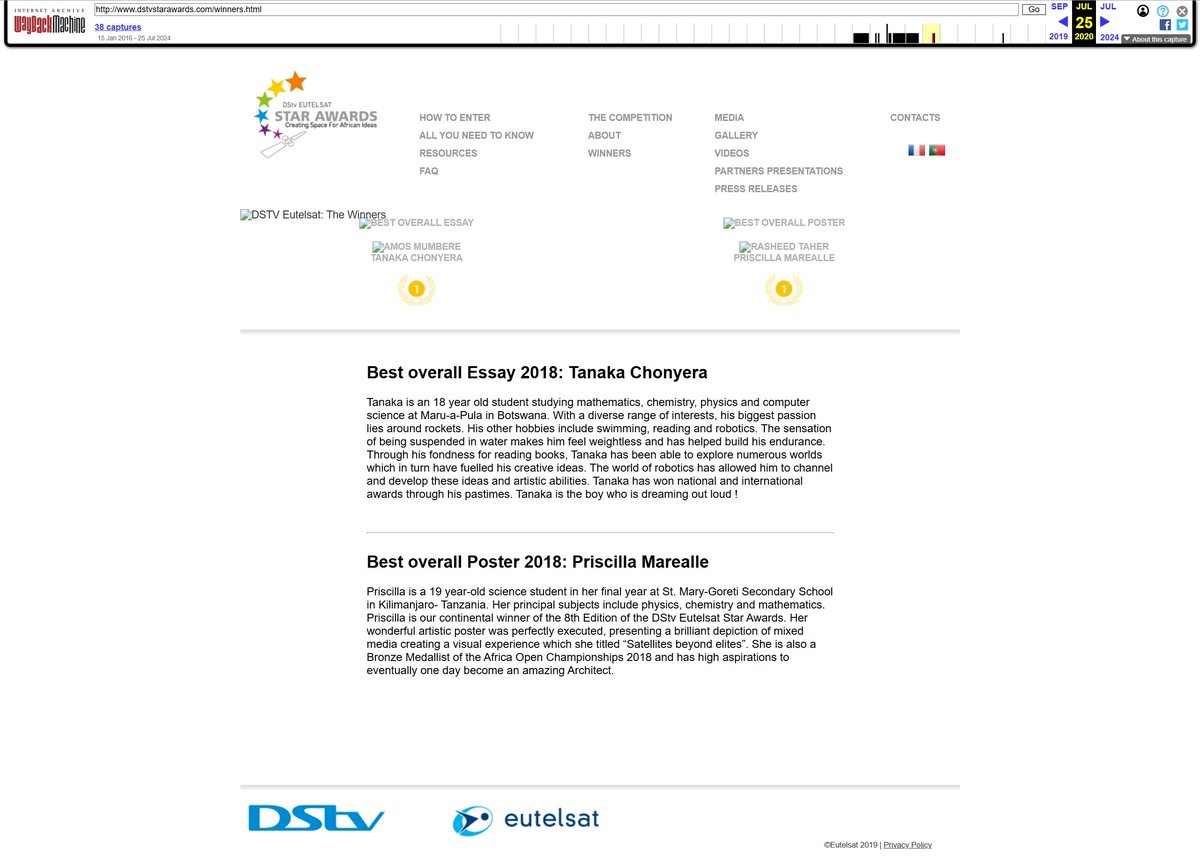
DStv Eutelsat: The Winners. Best overall Essay: Amos Mumbere, Tanaka Chonyera. Best overall Poster: Rasheed Taher, Priscilla Marealle.
Best overall Essay 2018: Tanaka Chonyera. Tanaka is an 18 year old student studying mathematics, chemistry, physics and computer science at Maru-a-Pula in Botswana. With a diverse range of interests, his biggest passion lies around rockets. His other hobbies include swimming, reading and robotics. The sensation of being suspended in water makes him feel weightless and has helped build his endurance. Through his fondness for reading books, Tanaka has been able to explore numerous worlds which in turn have fuelled his creative ideas. The world of robotics has allowed him to channel and develop these ideas and artistic abilities. Tanaka has won national and international awards through his pastimes. Tanaka is the boy who is dreaming out loud!
Best overall Poster 2018: Priscilla Marealle. Priscilla is a 19 year-old science student in her final year at St. Mary-Goreti Secondary School in Kilimanjaro, Tanzania. Her principal subjects include physics, chemistry and mathematics. Priscilla is our continental winner of the 8th Edition of the DStv Eutelsat Star Awards. Her wonderful artistic poster was perfectly executed, presenting a brilliant depiction of mixed media creating a visual experience which she titled "Satellites beyond elites". She is also a Bronze Medallist of the Africa Open Championships 2018 and has high aspirations to eventually one day become an amazing Architect.
DStv · Eutelsat · ©Eutelsat 2019 | Privacy Policy
Archived copy: web.archive.org, 25 July 2020 ↗ · Original URL (offline): http://www.dstvstarawards.com/winners.html
The competition website's About page: the prize terms
Read the text
DStv Eutelsat Star Awards. Navigation: How to enter, All you need to know, Resources, FAQ; The competition, About, Winners; Media, Gallery, Videos, Partners presentations, Press releases; Contacts.
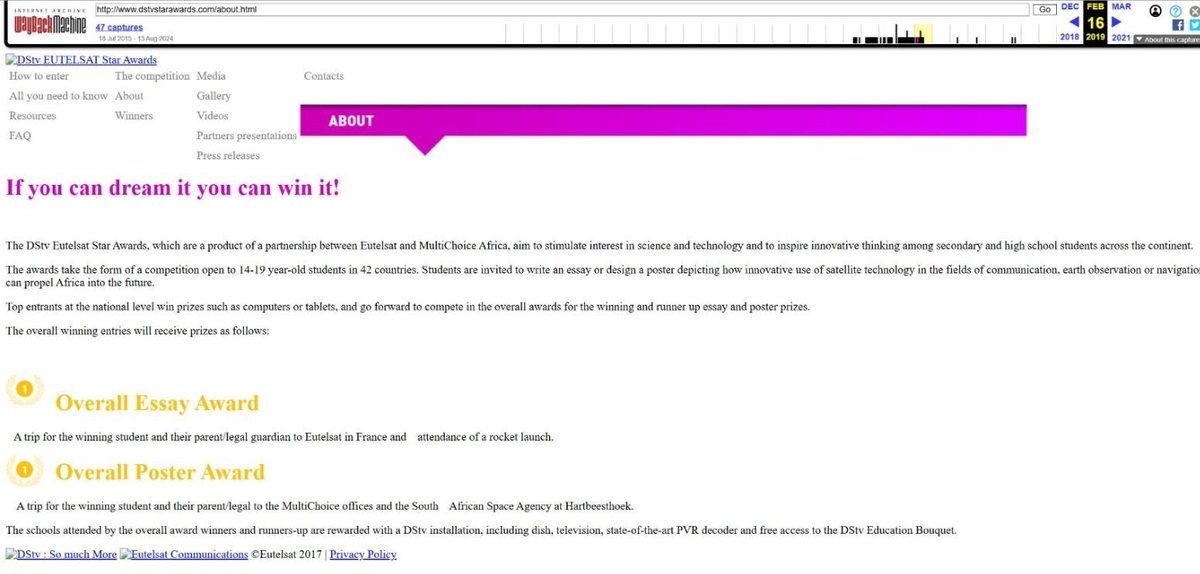
About. If you can dream it you can win it!
The DStv Eutelsat Star Awards, which are a product of a partnership between Eutelsat and MultiChoice Africa, aim to stimulate interest in science and technology and to inspire innovative thinking among secondary and high school students across the continent.
The awards take the form of a competition open to 14-19 year-old students in 42 countries. Students are invited to write an essay or design a poster depicting how innovative use of satellite technology in the fields of communication, earth observation or navigation can propel Africa into the future.
Top entrants at the national level win prizes such as computers or tablets, and go forward to compete in the overall awards for the winning and runner up essay and poster prizes.
The overall winning entries will receive prizes as follows:
Overall Essay Award: A trip for the winning student and their parent/legal guardian to Eutelsat in France and attendance of a rocket launch.
Overall Poster Award: A trip for the winning student and their parent/legal guardian to the MultiChoice offices and the South African Space Agency at Hartbeesthoek.
The schools attended by the overall award winners and runners-up are rewarded with a DStv installation, including dish, television, state-of-the-art PVR decoder and free access to the DStv Education Bouquet.
DStv: So much More · Eutelsat Communications · ©Eutelsat 2017 | Privacy Policy
Archived copy: web.archive.org, 16 February 2019 ↗ · Original URL (offline): http://www.dstvstarawards.com/about.html
Maru-a-Pula School: "MaP's Tanaka Chonyera Wins 'Star Award'"
Read the text
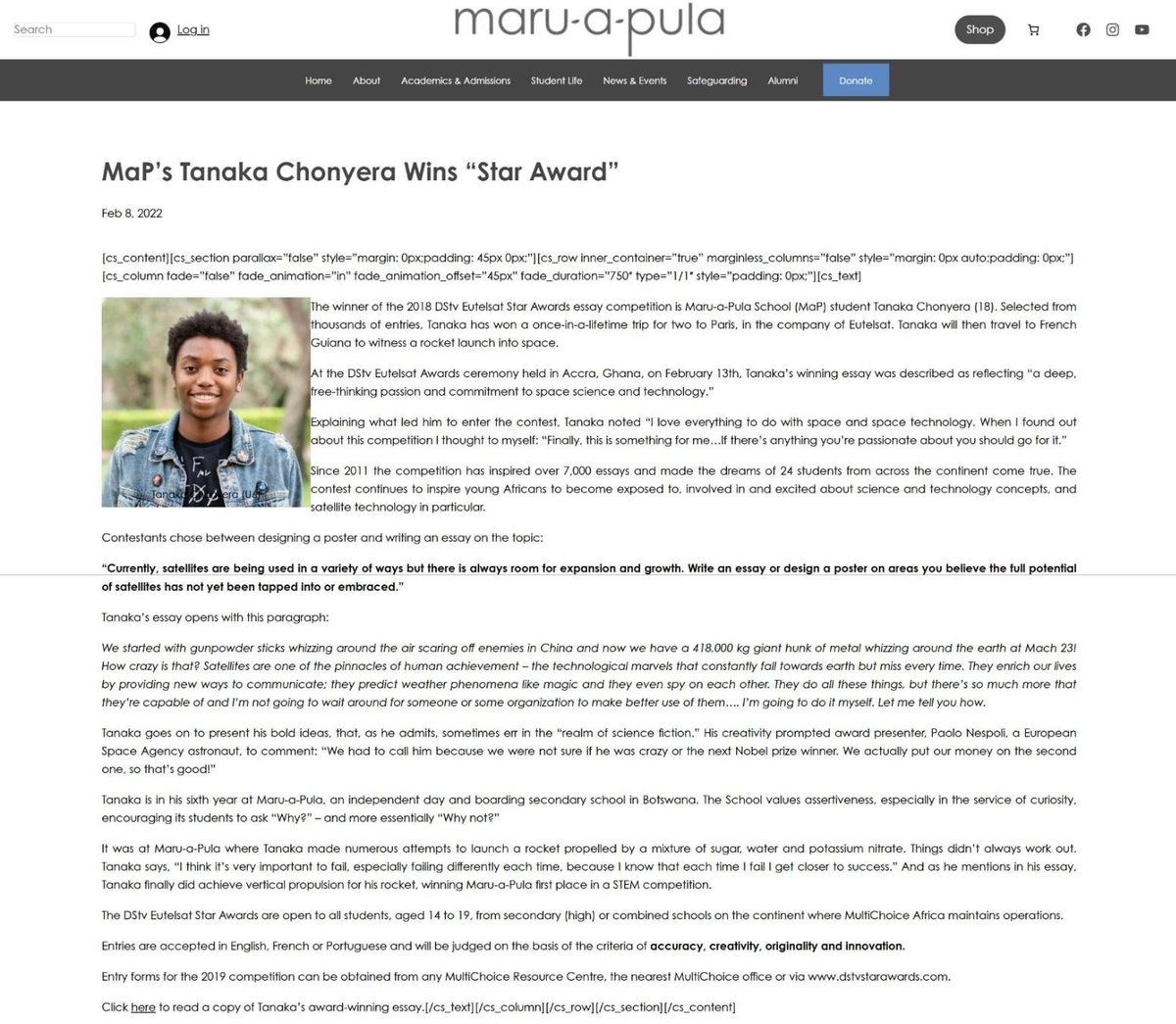
The winner of the 2018 DStv Eutelsat Star Awards essay competition is Maru-a-Pula School (MaP) student Tanaka Chonyera (18). Selected from thousands of entries, Tanaka has won a once-in-a-lifetime trip for two to Paris, in the company of Eutelsat. Tanaka will then travel to French Guiana to witness a rocket launch into space.
At the DStv Eutelsat Awards ceremony held in Accra, Ghana, on February 13th, Tanaka's winning essay was described as reflecting "a deep, free-thinking passion and commitment to space science and technology."
Explaining what led him to enter the contest, Tanaka noted "I love everything to do with space and space technology. When I found out about this competition I thought to myself: 'Finally, this is something for me.' If there's anything you're passionate about you should go for it."
Since 2011 the competition has inspired over 7,000 essays and made the dreams of 24 students from across the continent come true. The contest continues to inspire young Africans to become exposed to, involved in and excited about science and technology concepts, and satellite technology in particular.
Contestants chose between designing a poster and writing an essay on the topic: "Currently, satellites are being used in a variety of ways but there is always room for expansion and growth. Write an essay or design a poster on areas you believe the full potential of satellites has not yet been tapped into or embraced."
Tanaka's essay opens with this paragraph: We started with gunpowder sticks whizzing around the air scaring off enemies in China and now we have a 418,000 kg giant hunk of metal whizzing around the earth at Mach 23! How crazy is that? Satellites are one of the pinnacles of human achievement, the technological marvels that constantly fall towards earth but miss every time. They enrich our lives by providing new ways to communicate; they predict weather phenomena like magic and they even spy on each other. They do all these things, but there's so much more that they're capable of and I'm not going to wait around for someone or some organization to make better use of them. I'm going to do it myself. Let me tell you how.
Tanaka goes on to present his bold ideas, that, as he admits, sometimes err in the "realm of science fiction." His creativity prompted award presenter, Paolo Nespoli, a European Space Agency astronaut, to comment: "We had to call him because we were not sure if he was crazy or the next Nobel prize winner. We actually put our money on the second one, so that's good!"
Tanaka is in his sixth year at Maru-a-Pula, an independent day and boarding secondary school in Botswana. The School values assertiveness, especially in the service of curiosity, encouraging its students to ask "Why?" and more essentially "Why not?"
It was at Maru-a-Pula where Tanaka made numerous attempts to launch a rocket propelled by a mixture of sugar, water and potassium nitrate. Things didn't always work out. Tanaka says, "I think it's very important to fail, especially failing differently each time, because I know that each time I fail I get closer to success." And as he mentions in his essay, Tanaka finally did achieve vertical propulsion for his rocket, winning Maru-a-Pula first place in a STEM competition.
The DStv Eutelsat Star Awards are open to all students, aged 14 to 19, from secondary (high) or combined schools on the continent where MultiChoice Africa maintains operations. Entries are accepted in English, French or Portuguese and will be judged on the basis of the criteria of accuracy, creativity, originality and innovation. Entry forms for the 2019 competition can be obtained from any MultiChoice Resource Centre, the nearest MultiChoice office or via www.dstvstarawards.com.
Click here to read a copy of Tanaka's award-winning essay. (The essay is reproduced on this site under Writing.)
Source: maruapula.org, original post ↗
Partner listings and the Lilly Global Day of Service posts are captured under Web Captures above.